
The Uncompromising Compass
Ghassan Kanafani's Guide Through the Thorns of Struggle

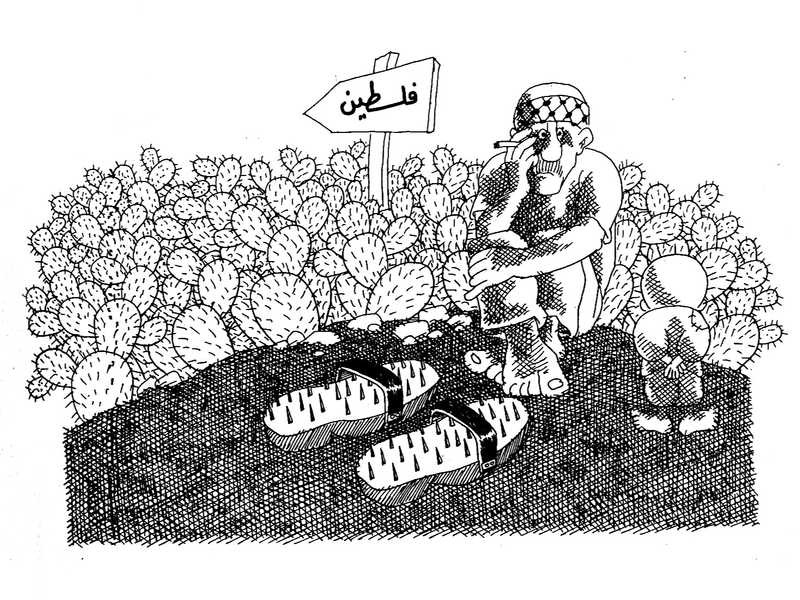
The character of Handala was like a spiritual icon of resistance, a reminder of the fall whenever I felt a sense of laziness or complacency. He is like a compass to me, and this compass always points to Palestine.
I am not tied to political storefronts; I am committed to a cause greater than all these crowds. I am the conscience of all the aware people whose interests are at stake but who are unable to express them.
This is how I understand the struggle: to stand tall like spears and never tire.
The road to Palestine is neither far nor near, it is the distance of revolution.
To be or not to be, the challenge is present and the responsibility is historic.
-Naji al-Ali.
Like any party or group—or any collective body striving toward justice—there must exist a reference point, a compass by which direction is set and corrected. Without such a guide, the movement fragments, drifts, and ultimately fails. The task, then, is not merely to adopt a reference, but to build it with clarity, rigor, and revolutionary intent. In the Palestinian cause, this compass has long been dual and deeply rooted: Ghassan Kanafani and Naji al-Ali. This is not an arbitrary selection of names. They are not mere representatives of a line or personal opinion. They are the crystallized conscience of our people at their most lucid and courageous. Whether a Palestinian intellectual teaching at Oxford or a fellah remembering the soil of their stolen land, Kanafani and al-Ali are beloved, iconic, and—most importantly—uncompromising.
To read Kanafani today, especially from within the belly of the empire—on unceded Indigenous land in so-called “British Columbia”, a province built on ongoing colonization and a state, Canada, deeply embedded in the catastrophe of Palestine and the imperialist plot—is to recognize the urgency of his theoretical clarity. His work is a compass we must not only keep but calibrate, a foundation upon which we must build. For the specificity of the Palestinian cause demands theory. As Kanafani himself wrote, “because of this very specificity, the need for a revolutionary theory intensifies, and because of the complexities specific to the Palestinian cause, the need for a guide to revolutionary action becomes more urgent than anywhere else.” That was over 50 years ago.
This guide must be grounded in a scientific vision of reality, not emotional reactivity. We cannot afford the luxury of disjointed activism or subjective outrage. In The Resistance and its Dilemmas, Kanafani warns of the pitfall of isolating fragments of reality: “The critical conscious mind commits an error when it forcibly imposes a state of stagnation on one single particle of this reality. This leads successively to a series of mistakes: arbitrarily separating this particle from an unlimited number of other particles, then forcibly immobilizing it, then studying or criticizing or measuring it in isolation from that dialectical link between action and knowledge.”
This fragmentation is a strategic death. It prevents us from seeing the connections between struggles—between the Palestinian resistance and the Indigenous sovereignty movements on whose stolen land we stand. It blinds us to the continuum of colonial violence linking the zionist project to the Canadian state. To fight one without the other is to fight a symptom, not the disease. This is not an abstract error; it is the deliberate outcome of the enemy’s oldest strategy, one Kanafani masterfully exposed.
The Strategic Crime of Division: How Reactionaries Do the Colonizer’s Work
A movement that fails to grasp the interconnectedness of struggle has already lost. It fails to grasp the enemy’s single greatest strategy: divide and conquer. Without a scientific, organized vision that sees the whole board, we inevitably fall into the traps set for us. We become reactive, fighting each other instead of the power that oppresses us all. This is not a theoretical danger; it is a documented, deliberate colonial plan.
Kanafani, in The Arab Cause During the Era of the United Arab Republic, exposes this with chilling clarity, drawing a direct line from internal sectarianism to the fulfillment of zionist and colonial aims:
“There is no doubt that the reactionary, the opportunist, the regionalist, and the sectarian - knowing that the word reactionary also means sectarianism - meet in their goals with the goals of Israel and colonialism, whether they intended that or not... In fact, the reliance of colonialism and Israel on this trio is almost complete. And it is natural that all their plans are based on cooperation with this trio to implement all their plans.”
He then provides irrefutable evidence, citing a secret Israeli plan from 1957 that explicitly called for the balkanization of the region through the creation of petty, sectarian statelets: a Druze state, a Shiite state, a Maronite state, an Alawite state, a Kurdish state, a Copt state. This was the blueprint.
“This passage indicates – conclusively – the extent to which Israel benefits from reaction, sectarianism, and regionalism in implementing its plans.. Whether the sectarians, regionalists, and reactionaries intended that or not...”
This is the ultimate consequence of a lack of a unified revolutionary vision. When we isolate particles of reality—when we prioritize our particularistic grievances over the collective liberation struggle, when we champion a narrow identity over the broader cause, or when we fail to connect Palestinian liberation to Indigenous sovereignty—we are not just being subjective or emotional. We are, knowingly or not, executing the enemy’s playbook. The enemy’s depth is not just in its tanks and jets; it is in its ability to turn us against ourselves. Therefore, to build a solid organization is to build a bulwark against this strategic fragmentation. It is to recognize that the reactionary and the sectarian, in their pursuit of narrow interests, are objective allies of colonialism.
Equally dangerous is the descent into emotional reactivity that enables this fragmentation. Kanafani identifies this as a core organizational dilemma: “However, another dilemma might be equal in seriousness, which is the effect of 'reactivity' in the organization, this effect which often leads to dangerous results, because it subjects an organization to the logic of reaction... There is no doubt that this reactive phenomenon, if left to its extremes, leads to dangerous organizational repercussions, as it destroys the hierarchy of constructive priorities, and leads to directing the entire organization towards the direction of a partial battle inflamed in its essence, at the expense of the central point of the battle.”
An organized movement, by contrast, assesses reality through a unified vision. It does not get swept away by the latest news cycle or the most visceral outrage. It plans. It evaluates with method, not emotion. Again, from Kanafani: “any evaluation process... must be armed with a methodology; otherwise, it ends up being mere subjective sensations and feelings that are subject, to this degree or that, to emotion and particulars, and haphazardly navigate the overall complexities surrounding the current experience.”
This call for a scientific, disciplined approach is a direct response to the historic weakness of Arab struggle. As noted in The Underlying Structure: “In the Arab struggle's journey, the organizational question has always been the fatal point of weakness.” The solution is to resolve ideological and practical issues “through scientific behavior, far from improvisation, emotionalism, and empiricism.”
Today, we are besieged by the opposite: what Kanafani, in Thoughts on Change and the 'Blind Language', diagnosed as a pervasive obscurity that serves the same function as sectarianism: disorientation. “In the past decade, what we can call a 'blind language' has been born in the region. Nothing is more prevalent in our daily lives than this blind language... Words have lost their value unless they are hollow, protecting nothing.” This language replaces strategy with poetry, clarity with emotional appeal. It is a form of evasion, even “a form of evasion through excessive self-flagellation,” which he called “the most dangerous aspect of our era.”
But this is more than just intellectual failure; it is a strategic crime. “Faced with such clarity of purpose... blind language becomes more than a meaningless phenomenon. It becomes a crime. It obstructs not only the path of young vanguards... but also the vision to discern the enemy's depth and danger—and thus to formulate solid strategies to confront and thwart their challenges.”
The alternative is the responsible objectivity Kanafani called for, an objectivity that recognizes the enemy's plan to divide us and organizes against it: “to dispense - as much as possible - with emotionalism, fanaticism, and a complete end to responsible objectivity in thinking. Anything contrary to this will not be considered, in national work, except a deviation from the principles required by the seriousness of the current situation... The nationalist thought today is based on the premise of unity in 'trying to understand it clearly and plan for it logically' and realize its danger responsibly... without fanaticism and without emotionalism. But with a responsible scientific approach.”
This approach is impossible without organization. Theory without structure is just prose. “We must organize ourselves politically and popularly, and create strong organizations capable of leading the battle and mobilizing all Arab energies to achieve unity. Without a strong organization, we will continue to suffer from chaos, randomness, and weakness.”
This is the compass Kanafani left us. To build an organized movement is to learn to navigate by it: to see reality as a connected whole—to tie the struggle against zionism to the struggle against imperialism, to see the shared thread of colonial displacement from Palestine to Turtle Island, and to recognize the sectarian and reactionary as the enemy's tool. It means replacing the blind language of hollow activism with the clear, uncompromising thinking of a unified revolutionary vision. It means making our reference point not just a martyred, beloved memory, but a living method. And it starts here, on stolen ground, with a conscious choice: to organize, to theorize, to connect, and to fight with the clarity our people and all the oppressed deserve.
Read also: The Deliberate Fracture.