
Staging Solidarity
Mehdi Hasan and the Limits of Permissible Discourse

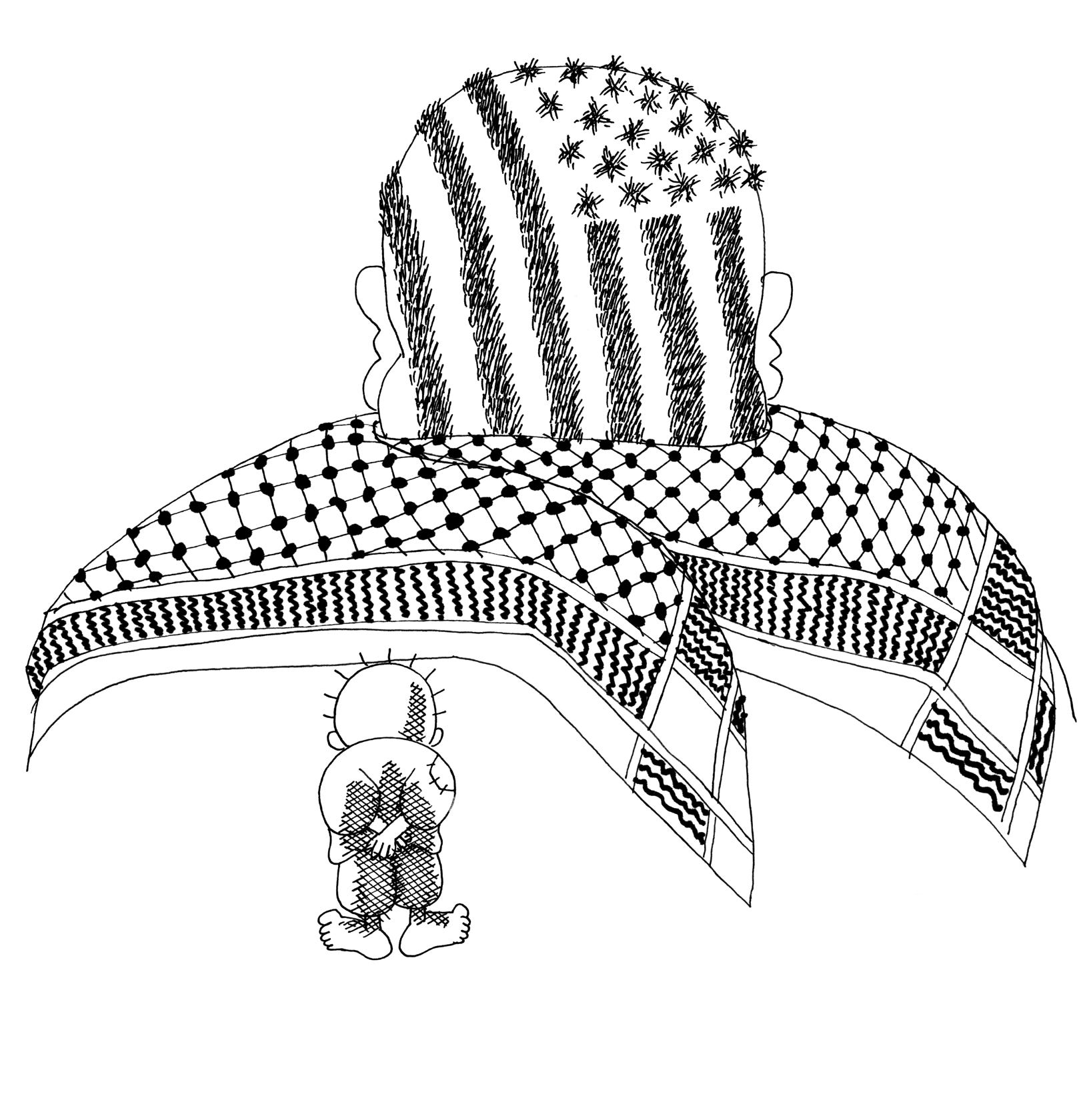
“Whoever wants to write for Palestine, and whoever wants to draw for Palestine, must know themselves: dead.”
“Personally, I am biased towards my class, biased towards the poor, and I do not deceive myself nor flatter anyone. The issue is clear and does not tolerate interpretation. It is the poor who die, who are imprisoned, and who endure real suffering.”
“I draw... I do not inscribe amulets, nor do I burn incense, but I draw. And if it is said that my brush is a surgeon’s scalpel, then I have achieved what I have long dreamed of achieving. I am not a clown, nor am I a tribal poet, of any tribe... I expel from my heart a burden that always returns heavy, but it is enough to give me a reason to live.”
“I have a stance towards the hardworking, oppressed, and historically wronged masses. I try to capture their concerns, and as a result, their worries blend within me. Under the shadow of these concerns, I paint, and I even find myself loving my own worries.”
“I belong to any resistance, not necessarily Palestinian. Any rifle aimed at the Israeli enemy represents me, and nothing else does.”
—Naji al-Ali.
Naji al-Ali drew with a key, not for awards, but for liberation; he spoke from the dirt of the refugee camp, not the podiums of diaspora fancy galas. His voice, like that of the Palestinian people themselves, was forged in the fire of direct struggle—uncompromising, clear, and paid for in blood. Today, however, a different chorus has arisen, one that often drowns out the grassroots with the amplified voices of professional commentators and well-funded organizations. These self-appointed gatekeepers, operating from the comfortable distance of Washington and London, have created an economy of solidarity where symbolism is traded for legitimacy, and the Palestinian cause is reshaped into a palatable product for Western capitalist consumption. It is within this theater of managed activism that the performance of Mehdi Hasan unfolds—a perfect case study in how the machinery of power co-opts the language of resistance to ultimately defang it.
There is a familiar theater performed within the machinery of Western power. It is a play of managed dissent, a spectacle of contained criticism designed not to challenge the foundations of empire, but to legitimize them. At the center of this stage, for a time, stood Mehdi Hasan—a figure whose career trajectory serves not as a story of redemption, but as a perfect case study in the rigid boundaries of permissible discourse on Palestine. His journey from a would-be attacker of his own community to a celebrated “firebrand” and finally to an independent “voice for Palestine” is not one of moral evolution, but of a political operative adapting his product to the market. To understand this is to understand how the propaganda model truly functions.
The foundational evidence of this operative nature is not hidden. It lies in a 2011 letter to the Daily Mail—a publication notorious for its xenophobia and anti-Muslim bigotry—where a young Mehdi Hasan, in a staggering act of opportunism, allegedly offered his services to “attack Muslims and the left.” This was not the misstep of a naive “journalist,” but the calculated proposal of a political mercenary, revealing a core identity willing to leverage his own background to service the very narratives of oppression for a platform. As the astute analyst Ali Abunimah has highlighted, the Daily Mail itself published excerpts of this solicitation. This is the original sin that permanently stains his subsequent claims of genuine conviction.
His tenure at MSNBC was the full flowering of this role, perfected. Celebrated for his “sharp,” “viral” interrogations, he was granted a platform to perform a carefully curated dissent. His criticism, while often bracing, operated within a strict liberal framework: he would challenge the tactics of the Israel lobby, but not the settler-colonial structure of the state itself; he would question casualty figures, but not the underlying logic of a “right to defend” an apartheid regime. In essence, he became the system’s safety valve, a proof of its own supposed openness, all while ensuring the foundational pillars of U.S. foreign policy remained firmly intact.
This corporate repackaging, however, could not erase the judgment from within Gaza itself. At the genocide’s onset on October 8th, the martyr Refaat Alareer—whose voice would soon be stolen by an American/Israeli bomb—warned that Hasan’s rhetoric was a facade; he was no friend to Palestine, but a purveyor of the propaganda that justifies slaughter.
The ultimate proof of this containment came when the facade cracked. In late 2023, as Israel unleashed its genocidal campaign on Gaza, Occupied Palestine, Hasan’s coverage began to approach the unvarnished truth that Palestinians and their allies had been articulating for 76 years. The mask of managed dissent slipped. And the system’s response was swift and decisive: his show was demoted, then canceled. His most potent criticism of the Democratic administration and its role as both “arsonist and firefighter” came after his firing was announced. The timeline is damning: his “principled” stance found its full voice only when the corporate paycheck and platform were revoked. This is neither courage nor journalism; it is the sound of shackles being removed, revealing that they were worn by a willing participant all along.
Now, we must add the final, damning layer to this portrait: the context of his nationality. He is a British subject, a citizen of the very empire whose Balfour Declaration and colonial mandate laid the groundwork for the Nakba. There is a profound irony, a deep historical insult, in a British demagogue—an opportunist from the heart of the former colonial power—now positioning himself as a leading voice on Palestinian liberation. It is the latest chapter in a long history of outsiders shaping, and ultimately distorting, the Palestinian narrative to suit their own purposes. His is not a voice of solidarity; it is an echo of the colonial gaze, repackaged for a liberal audience.
Why should we listen? The Palestinian struggle is not a trend to be discovered, nor a career path to be pivoted towards. It is a lifelong commitment to justice, borne by a people who have paid the price of principle with their land, their liberty, and their lives. Our voices—the voices of the colonized, the displaced, the martyred—do not need validation from those who once auditioned to attack us. We have no need for a propagandist of the oppressor, a British opportunist, who has simply found a new, more lucrative audience.
Consistency is the only true measure of integrity in a struggle against annihilation. Mehdi Hasan’s story is a masterclass in inconsistency, a journey mapped not by a moral compass, but by the shifting winds of careerism and corporate permission. It is a stark reminder that the machinery of Western power is adept at creating its own opposition, the better to control it. Our duty is not to celebrate the managed dissident who finally breaks character, but to steadfastly center the voices that have never needed a script, have never been for sale, and require no permission from London or New York to speak their own truth.
This essay is short, as are the principles of the Hasans.